





We practice a minimally invasive approach to your foot or ankle problem with surgery as the last option.
We practice a minimally invasive approach to your foot or ankle problem with surgery as the last option.
Trusted Experts in Foot Care
Avid Foot & Ankle is a full service podiatric center dedicated to helping our patients achieve the best possible foot and ankle health. We create customized treatment plans that are focused on the individual’s needs, condition, and lifestyle. Our practice serves the communities of Little Elm, Prosper, Frisco, Savannah and Aubrey!
We offer a wide range of foot and ankle treatments with a special interest in sports medicine and both conservative and surgical interventions. We welcome patients of all ages including pediatrics and adolescents. Athletes and those who lead an active lifestyle are also encouraged to come and discover our non-invasive alternative treatments for their foot and ankle ailments.
Our office staff is always friendly and accommodating. We thoroughly clean and disinfect our office after every patient visit to ensure the health and safety of both our staff and patients.
Welcome to our practice where we have an avid interest in your foot and ankle health!

When it comes to receiving foot and ankle surgery, it’s typically a case by case situation. Some factors that play a role in whether or not you need surgery include the severity of your symptoms as well as your response to other conservative, noninvasive treatment methods.
There are a number of different foot and ankle conditions that may benefit from surgery as a treatment option. Bunions, hammertoe, metatarsal, ankle arthritis, Achilles tendon disorders, Morton’s neuroma, tibialis posterior disorder, and plantar fasciitis are all conditions that may require surgery as a treatment option, depending on their severity. Long-lasting pain relief is typically the biggest takeaway from having surgery performed to remedy your condition.
In order to best prepare for surgery, make sure you have a consultation with your podiatrist about your overall health, discuss any possible changes in medication, and ask any questions you may have about the procedure to go into the treatment with a clear head. In some cases, you may have to refrain from eating and drinking a few hours before the procedure, so make sure you understand what must be done on your end beforehand.
As for recovery, again, this will typically vary case by case and will be dependent on your condition and the type of surgery performed. Generally, it’s recommended that you get plenty of rest, ice the affected area, compress the wound to aid in further strain, and keep the area elevated to reduce any possible swelling. In some cases, your podiatrist may encourage you to use bandages, splints, surgical shoes, casts, crutches, orthotics, or a cane, depending on how much weight they believe your foot and ankle can bear.
If you’d like to determine whether surgery is the best option for you and your foot condition, consult with a podiatrist who will be able to give you a proper diagnosis and aid you with your decision.
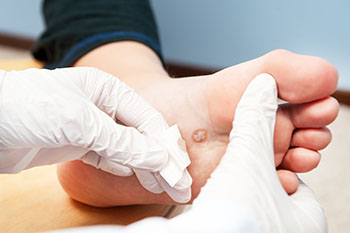
Plantar warts are growths that typically appear on the heels or other weight-bearing areas of the feet. These warts are caused by the human papillomavirus (HPV). The virus enters the body through breaks in the skin, such as cuts, that are on the bottom of the feet. Plantar warts are more likely to affect children and teenagers, people with weakened immune systems, people who have a history with plantar warts, and people who walk barefoot in environments exposed to a wart-causing virus.
If you suspect you have plantar warts, you may have the following symptoms: pain or tenderness while walking, a lesion that interrupts the ridges in the skin of your foot, small fleshy lesions on the bottom of the foot, or a callus where a wart has grown inward over a well-defined spot on the skin.
HPV causes plantar warts to form and is very common. There are more than 100 kinds of the virus in existence. However, only a few of them cause warts on the feet. The other types of HPV are likely to cause warts on other parts of the body.
If you have plantar warts, your podiatrist may try different treatment methods depending on your specific case. Some treatments for plantar warts are peeling medicines (salicylic acid), freezing medicines (cryotherapy), or surgical procedures. Laser treatments and vaccines are also used to treat plantar warts.

As with any sporting activity, it’s very important to be aware of the safety precautions needed to help avoid injury and reduce risk. With that being said, injuries of the foot and ankle are fairly common among those who actively participate in sports.
Some sports may be considered more dangerous in terms of foot and ankle injuries compared to others. These sports may include basketball, running, football, soccer, and dancing. Sports that require tightly worn shoes as well as have a particular focus on jumping typically run a higher risk of injury. Because the feet are considered the foundation of the body, help us stay balanced, and enable us to perform our everyday activities, professional help should be sought at the first instinct of something gone wrong.
Some common contributors that lead to foot and ankle injuries in the realm of sports include not stretching properly or failing to warm up, wearing the incorrect footwear needed for your particular sport, as well as not taping or providing your feet and ankle with the needed support. There are a number of foot conditions that can develop if certain safety measures are ignored. Some of the most common conditions related to sports injuries include Achilles tendinitis, plantar fasciitis, and stress fractures, to name a few.
Achilles tendinitis affects the largest tendon in the body, the Achilles tendon. This type of injury typically occurs because of overuse. The main function of the Achilles tendon is to transmit power from the calf muscles to the heel and the foot. When this tendon is harmed, it can be extremely painful and may lead to further complications including tears, ruptures, tendinitis, peritendinitis, tendinosis, tendinopathy, and bursitis.
Plantar fasciitis may occur when the band of tissues that support the arch of your foot experience too much stress. These tissues can become strained from frequently performing sporting activities, thus causing inflammation and pain at the bottom of the heel.
Stress fractures can arise due to a lack of conditioning, use of improper equipment or technique, and repetitive stress placed on the foot and ankle. A stress fracture is a small crack in the bone that can be very painful and cause a great deal of discomfort.
If you commonly participate in sporting activities and would like more information about how to keep your feet and ankles safe, as well as learn more about your treatment options if injured, we recommend you speak with a podiatrist for professional guidance and care.

Plantar fasciitis affects the plantar regions of the foot, namely the heel, arch, and midfoot. When too much stress is put on the plantar fascia, or the connective tissue that stretches from the heel to the ball of your foot, inflammation, overtightening, and tearing may arise. This can cause foot pain. Because of plantar fasciitis, you may experience tearing with the first steps you take in the morning each day.
A certain trigger that may cause stress to the plantar fascia includes poor arch support, which is brought upon by frequently walking barefoot or wearing shoes with improper arch support. Other causes include obesity or a sudden increase in weight, increased physical activity, weak foot and ankle muscles, tight calf muscles, and arthritis.
If you’re feeling pain after sitting, walking, or standing for a long period of time, as well as when you first step out of bed or climb stairs, you may be showing signs of plantar fasciitis. To know for sure what’s causing you pain, it’s best that you get an x-ray taken of your foot.
Because plantar fasciitis is known to worsen over time, it’s recommended that you meet with a podiatrist as soon as possible for a proper diagnosis and advised treatment plan.
I had the pleasure of visiting Dr. Kim for my foot issues, and I couldn't be more impressed with his expertise and professionalism. Dr. Kim's compassionate care and attention to detail truly set him apart. He took the time to thoroughly explain my condition and treatment options, making me feel comfortable and well-informed throughout the process...
Had a wonderful experience with Dr. Kim. He explained the options we had to treat an ingrown toenail. He was thorough in discussing the procedures, benefits and concerns of each option, the treatment process as a whole, and the related costs. Dr. Kim is very friendly, pleasant to talk to and willing to answer all our questions to help us decide the correct procedure. I cannot say enough good things about Dr. Kim.
Dr. Kim is one of the few doctors who truly puts his patients' well-being first. He listens, offers effective treatments, and even considers your financial situation. What really stands out is the personal touch—his team follows up after your visit to check in, which makes the whole experience feel warm and caring. It’s rare to find that level of care these days!!

Connect With Us